
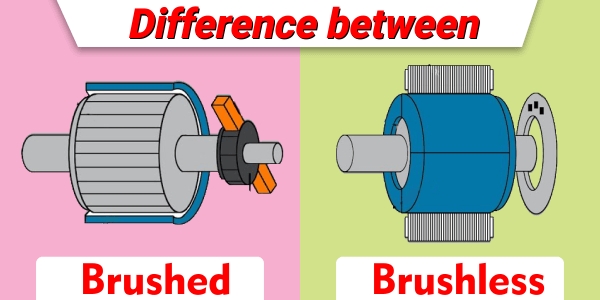
A brushed DC motor uses brushes and a commutator to switch current in its rotating windings. A brushless DC motor uses an electronic drive to switch current in the stator. Choose between them using the required operating point, duty cycle, control needs and total system cost—not the word “brushless” alone.
What does PMDC mean?
PMDC means permanent-magnet DC. In a conventional brushed PMDC motor, permanent magnets provide the stator field, while the armature winding and commutator rotate. PMDC is not a synonym for every DC motor: wound-field motors and electronically commutated motors use different arrangements. Torque depends on current and the motor design; speed also changes with supply voltage and load.
Compare the complete motor and drive
| Decision | Brushed PMDC | Brushless DC |
| Commutation | Mechanical brushes and commutator | Electronic switching matched to rotor position |
| Basic drive | A suitable DC power stage; an H-bridge where reversal is needed | A compatible multi-phase inverter and commutation control |
| Wear | Brush and commutator wear as well as bearings | No brush wear; bearings and other parts still wear |
| Control | Can use speed or position feedback | Can use sensors or a supported sensorless method |
| Cost comparison | Include replacement access and duty cycle | Include controller, sensors, commissioning and wiring |
When a brushed motor remains a practical choice
Intermittent actuators with straightforward control can suit a brushed motor. Establish the expected starts per day, run duration, reversal pattern and load before estimating service life. A lower motor price is useful only if the assembly can meet its duty and maintenance requirements. Do not apply wound-field speed-control advice directly to a permanent-magnet motor.
When to evaluate brushless operation
Long operating periods, frequent speed changes or a need to remove brush wear are reasons to evaluate BLDC. Removal of brushes does not eliminate friction, heat or noise. Compare measured motor-and-controller efficiency at the working point, bearing life, temperature rise and sound under the same load. An unloaded demonstration does not establish performance in a tool or appliance.
Questions to settle before ordering
- Provide supply voltage range, load speed, continuous torque and short-duration peak torque.
- Define start/stop cycles, ambient temperature, cooling and acceptable noise.
- Confirm whether reversal, braking, position holding or speed feedback is required.
- Test the complete mechanism: gearbox, bearings, seals and controller all affect performance.
Compare current brushed DC motors
Compare current brushless DC motors