
As household and commercial stand mixers continue to evolve toward more compact and multifunctional designs, the motor and transmission system must deliver sufficient power within a limited installation envelope.
Reducing the vertical height of the mixer head is particularly challenging because the drive system must simultaneously satisfy requirements for power output, torque, speed, functional coverage, service life, and noise performance.
To address these requirements, Power Motor developed a compact stand mixer drive solution based on a flat motor architecture, offset stator winding design, optimized electromagnetic parameters, and dual-output gearbox.
The solution is designed to reduce the vertical installation space of the drive system while maintaining the required operating performance and supporting both high-speed and low-speed functions.
1. Flat Motor Design for Compact Mixer Architecture
The first engineering objective was to reduce the vertical installation space occupied by the motor.
Power Motor adopted a flat motor architecture with an offset stator winding configuration. By optimizing the position and arrangement of the stator winding within the motor structure, the vertical dimension of the drive system can be reduced while maintaining the required electromagnetic performance.
Compared with conventional motor architectures, this approach provides greater flexibility for OEMs developing compact stand mixers and helps create a lower-profile mixer head.
The design optimization focuses on the relative geometry and electromagnetic configuration rather than simply reducing the overall motor size.
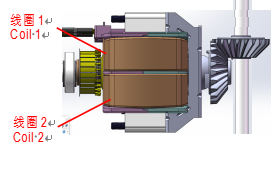
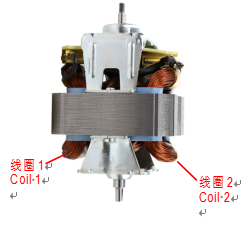
Figure 1 – Flat Motor Winding Layout and Motor Sample
2. Electromagnetic Optimization for Required Power
Reducing motor height can potentially affect the magnetic circuit and output performance. Therefore, the lamination configuration and electromagnetic parameters must be optimized together.
Power Motor optimized the lamination thickness, winding configuration, and electromagnetic parameters within the available motor envelope.
The engineering objective was to reduce the vertical installation space while maintaining the required operating power and torque.
Under the defined laboratory test conditions, representative maximum-efficiency-point data are shown below:
| Parameter | Optimized Design | Reference Design |
| Maximum efficiency | 55.8% | 71.2% |
| Input power | 748.2 W | 511.3 W |
| Output power | 417.6 W | 363.7 W |
| Torque | 283 mNm | 255 mNm |
* Representative test data measured under defined test conditions. Actual performance may vary depending on supply voltage, load, operating speed, temperature, control strategy, manufacturing tolerance, and application conditions. The data are provided for engineering reference only and do not represent a universal specification for all Power Motor products.
The representative data indicate that the Optimized Design provides higher measured input power, output power, and torque at the specified test point, while the measured efficiency is lower than that of the Reference Design.
This comparison highlights an important engineering principle: for a compact stand mixer motor, performance should be evaluated according to the complete application requirement rather than efficiency alone.
3. Dual-Output Gearbox for Multiple Mixer Functions
A multifunction stand mixer requires different speed and torque characteristics for different applications.
High-speed operation may be required for:
- Milkshake preparation
- Juice and vegetable blending
- Grain, bean, and meat processing
- Smoothie and ice-blended food preparation
Low-speed operation is generally required for:
- Dough mixing
- Egg beating
- Other low-speed mixing applications
A single transmission ratio makes it difficult to optimize both operating ranges simultaneously.
Power Motor therefore developed a dual-output gearbox architecture consisting of a high-speed 1:1 bevel-gear transmission and a low-speed planetary gear reduction mechanism.
3.1 High-Speed Output: 1:1 Bevel Gear
The high-speed output adopts a 1:1 bevel-gear transmission. The primary engineering purpose is to change the direction of power transmission while maintaining the corresponding speed ratio. This allows the high-speed output to be positioned more efficiently within the mixer head.
The architecture supports high-speed functions such as blending, juice preparation, food processing, and smoothie preparation, while helping reduce the vertical installation space required by the drive system.
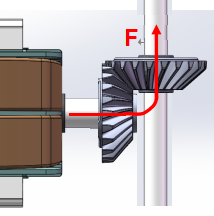
Figure 2 – High-Speed 1:1 Bevel-Gear Power Flow
3.2 Low-Speed Output: Planetary Gear Reduction
The low-speed output uses a planetary gear reduction mechanism. The planetary transmission reduces rotational speed and increases available output torque, providing suitable characteristics for demanding low-speed applications such as dough mixing.
The combination of the high-speed bevel-gear output and low-speed planetary output allows one compact drive system to support multiple operating modes without removing the required functions of the stand mixer.
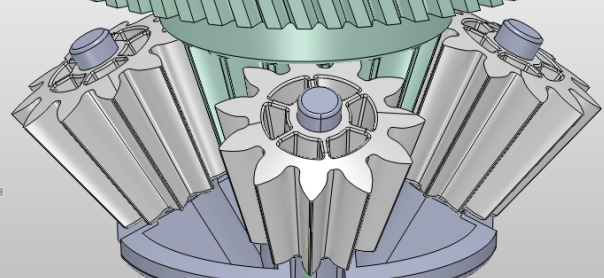
Figure 3 – Low-Speed Gearbox Architecture
4. Torque-Speed Characteristics
Torque performance is a key parameter when evaluating stand mixer drive systems because different attachments and food loads generate different operating conditions.
Power Motor evaluates the motor and transmission system through torque-speed testing to identify suitable operating ranges for the two output paths.
The high-speed output is designed for high-speed blending and mixing, while the planetary output provides a lower-speed and higher-torque operating range for heavier mixing applications.
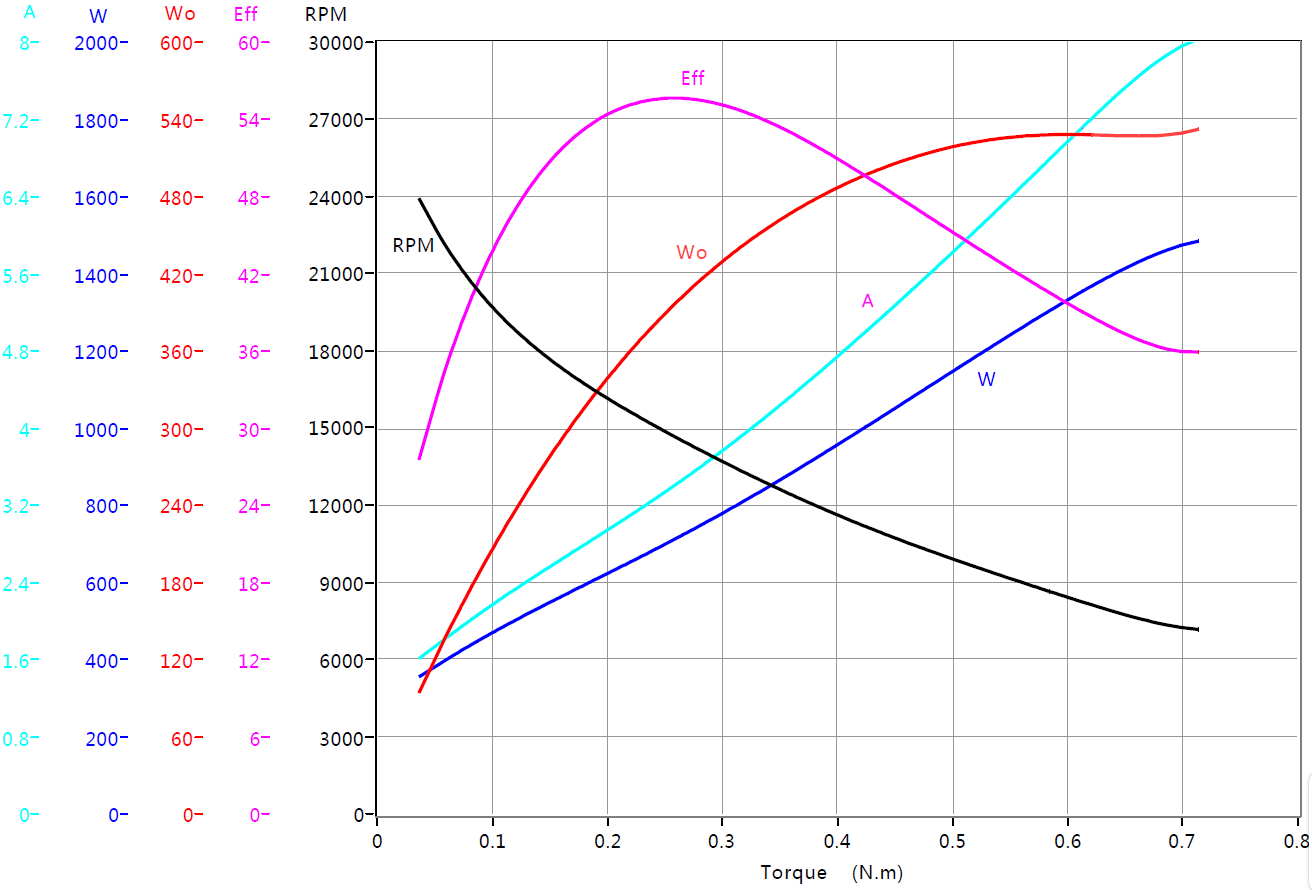
Figure 4 – Representative Torque-Speed Curve
Engineering disclaimer: The torque-speed curve represents measured data under defined laboratory conditions and is intended for engineering reference. Actual output characteristics may vary depending on gearbox configuration, load, supply conditions, temperature, control strategy, attachment design, and appliance integration.
5. Service-Life Verification
Reliability is an important consideration for both household and commercial stand mixers.
Power Motor conducted separate service-life evaluations for the two gearbox output paths based on simulated consumer usage conditions.
High-Speed Bevel-Gear Output
Under the defined life-test conditions, the high-speed bevel-gear output completed the specified test cycle corresponding to the targeted consumer usage period.
Low-Speed Planetary-Gear Output
Under the defined life-test conditions, the low-speed planetary-gear output also completed the specified test cycle corresponding to the targeted consumer usage period.
The testing was designed to simulate representative consumer usage patterns rather than continuous operation under a single fixed load.
Engineering disclaimer: The service-life results are representative data obtained under defined test conditions. Actual product life depends on operating frequency, load, duty cycle, attachment configuration, environmental conditions, maintenance, manufacturing variation, and customer usage patterns. The test results should not be interpreted as a guaranteed service-life specification for every application.
6. Noise Performance
Noise is another important consideration in stand mixer development, particularly for household kitchen appliances.
Under the defined noise-test conditions, the motor was evaluated at a representative high-speed operating point.
The test conditions included:
- Ambient noise: ≤20 dB(A)
- Test speed: 15,000 RPM ±500 RPM
- Single-motor noise requirement: ≤80 dB(A)
Under the defined test conditions, the measured single-motor noise was within the specified ≤80 dB(A) requirement.
Engineering disclaimer: The noise data are representative measurements obtained under defined laboratory conditions. The result applies to the motor-level test and should not be regarded as the noise specification of a complete stand mixer. Final appliance noise depends on housing structure, gearbox configuration, mounting method, attachment, acoustic insulation, operating speed, and overall appliance design.
7. Integrated Engineering Approach
The development of a compact stand mixer motor requires more than reducing motor dimensions.
Power Motor evaluates the complete drive system across several engineering dimensions:
- Motor architecture
- Stator winding configuration
- Electromagnetic parameters
- Lamination configuration
- Gearbox architecture
- Torque-speed characteristics
- Service life
- Noise performance
- Appliance integration
This integrated approach enables engineers to balance compactness, power density, transmission performance, reliability, and acoustic performance according to the customer's actual application requirements.
8. Applications
The compact dual-output drive architecture is suitable for:
- Household stand mixers
- Commercial stand mixers
- Multifunction food-processing equipment
- Compact kitchen appliances requiring high- and low-speed outputs
The motor and gearbox can be customized according to the customer's requirements for installation envelope, power, speed, torque, transmission ratio, duty cycle, service life, and noise.
Conclusion
Developing a compact stand mixer motor requires coordinated optimization of the motor architecture, electromagnetic system, gearbox, output speed, torque, service life, and noise performance.
Power Motor's solution combines a flat motor architecture, offset stator winding design, optimized lamination configuration, 1:1 high-speed bevel gear, and low-speed planetary gear reduction to create a compact dual-output drive system.
The representative performance, torque characteristics, service-life evaluations, and motor-level noise measurements provide an engineering basis for evaluating the solution in household and commercial stand mixer applications.
For OEM and ODM customers seeking to reduce mixer-head installation space while maintaining required power and multifunctional operation, Power Motor can develop customized motor and gearbox solutions based on the actual application requirements.
References
[3] Power Motor R&D Center. Representative Motor Performance and Reliability Evaluation Data for Compact Stand Mixer Applications. Internal Engineering Data, tested under defined test conditions.
Engineering Data Disclaimer
All performance figures, test results, curves, and engineering data presented in this article are representative data obtained under defined test conditions and are provided for technical reference only. Actual performance may vary depending on application conditions, electrical input, load profile, operating speed, temperature, control strategy, gearbox configuration, manufacturing tolerances, appliance integration, and other factors. Final specifications and performance commitments shall be confirmed through application-specific engineering validation and mutually agreed technical specifications.
Customer-specific dimensions, interfaces, drawings, and confidential product information are intentionally omitted from this technical article.