
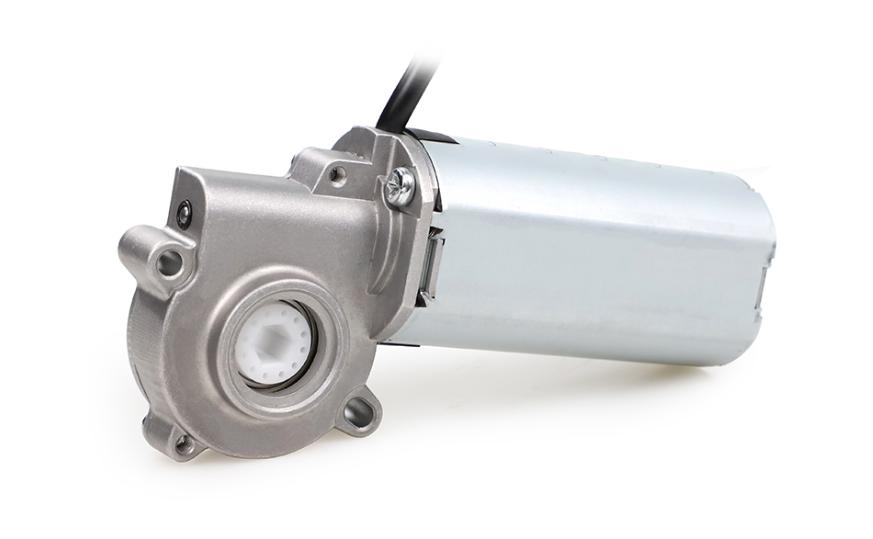
A worm gear motor combines a motor with a worm-and-wheel reduction. It can provide a compact right-angle transmission, but self-locking is conditional. Do not treat a worm gearbox as a guaranteed brake simply because it has a high reduction ratio.
How the reduction works
The rotating worm advances the wheel teeth through sliding contact. The ratio depends on wheel tooth count and the number of worm starts. A larger reduction lowers output speed; available output torque remains limited by tooth strength, bearings, lubrication and temperature. Sliding friction creates losses that must be included when checking continuous duty.
Why self-locking needs verification
Backdriving behavior depends on geometry and friction. Lead angle, lubrication, surface condition and operating conditions matter. A unit that resists motion in one static test may behave differently with vibration or changed conditions. KHK’s technical information identifies self-locking as a condition-dependent property; it is not a substitute for a system-level load-holding design.
What to specify for a holding application
| Requirement | Evidence to obtain |
| Load held with power off | Specified backdrive or holding capability for the exact gearbox |
| Vibration or impact | Test conditions representative of the installed mechanism |
| Long duty | Temperature and lubrication limits at the working load |
| Suspended or safety-relevant load | An appropriate independent holding/braking provision and system validation |
| Accurate positioning | Backlash, compliance and feedback location |
How to change output speed
Use a motor and compatible drive that support the required speed range, or select a different ratio. Changing the worm gearbox ratio is a mechanical selection decision, not an electronic speed command. At low motor speed, verify cooling and torque; at high input speed, check the gearbox input limit and heat generation.
Questions before selecting a worm gear motor
- What output torque is continuous, and what is only a short peak?
- Must the load remain stationary without power, and what happens if it moves?
- What vibration, temperature and lubrication conditions apply?
- Is the expected backlash acceptable after the required service life?
- Can the complete assembly dissipate heat during the longest run?
Technical reference
KHK: worm gear selection and self-locking technical information