
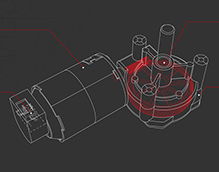
Select a gear motor from the speed and torque required at the output shaft. Then check the motor working point, gearbox ratings, duty cycle and mechanical loads together. Choosing only by voltage, motor power or the largest reduction ratio can produce a slow, hot or short-lived assembly.
Calculate the first working point
For reduction ratio i = motor speed / output speed, output speed is approximately motor speed divided by i. Output torque is approximately motor torque × i × gearbox efficiency. These are sizing relationships, not permission to exceed a gearbox rating. Use the actual efficiency at the working condition and verify continuous and intermittent torque limits.
Illustrative calculation, not a product rating: a motor running at 3,000 rpm through a 50:1 gearbox gives about 60 rpm. With motor torque 0.05 N·m and assumed gearbox efficiency 0.70, estimated output torque is 1.75 N·m. The selected gearbox must still be rated for that torque, input speed and duty. Startup friction and acceleration need separate checks.
Choose the gear arrangement
| Arrangement | Typical selection reason | What still needs checking |
| Spur | Straightforward parallel-shaft reduction | Available stages, package size, sound and backlash |
| Planetary | Compact coaxial arrangement | Torque rating, load sharing, backlash and bearing limits |
| Worm | Right-angle layout and substantial reduction | Efficiency, heating and actual backdriving behavior |
Brushed or brushless gear motor?
Both motor types can drive a gearbox. A brushless gear motor includes electronic commutation requirements as well as mechanical reduction. Choose the motor from its duty and control needs, then match the gearbox. The absence of brushes does not remove gearbox wear, backlash or the need for appropriate lubrication.
Specify the complete load cycle
- Required output speed and continuous torque, plus starting and acceleration torque.
- Run time, rest time, starts and reversals per hour.
- Radial and axial shaft loads, couplings, mounting orientation and available space.
- Backlash and positioning tolerance at the load, not only at the motor shaft.
- Ambient temperature, contamination, lubrication and service-life requirements.
Avoid three common sizing errors
Do not use stall torque as a continuous rating. Do not assume the next larger ratio can transmit proportionally more torque. Do not use motor-side encoder resolution as the complete output-position accuracy: backlash, compliance and gearbox variation also contribute. Validate a candidate using the actual mechanism and duty cycle before committing to production.
Worm gear behavior and load holding