
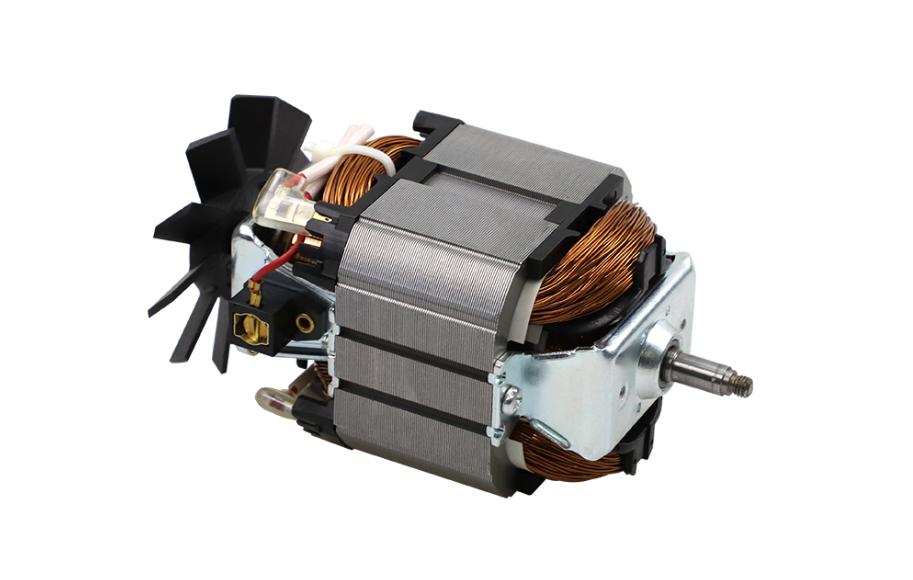
Select a blender motor by its loaded operating point, duty cycle, drive and thermal limits, rather than price or no-load speed alone.
Separate input power from shaft output
Electrical input power and mechanical shaft output are different quantities. Check which quantity a datasheet specifies and at what operating condition. Compare candidate motors at the required shaft speed and torque; a larger input-watt figure alone does not establish better blending performance.
Define load and duty before comparing motor routes
| Selection item | Information to confirm |
| Load | Tool geometry, mixture, starting load, working torque and abnormal blockage |
| Duty | Run time, rest time, repeated starts and expected operating cycles |
| Drive and supply | Supply conditions, motor configuration, speed range and protection |
| Mechanical interface | Envelope, shaft, mounting, coupling and cooling path |
Brushed and brushless routes should be compared at the same duty and in the intended appliance. Brush wear, bearing loads, drive losses, cooling and the driven mechanism all affect the result. Motor type alone does not establish noise, efficiency or service life.
Understand insulation class and temperature rise
| Insulation thermal class | Temperature designation |
| A | 105°C |
| B | 130°C |
| F | 155°C |
| H | 180°C |
These temperature designations describe the insulation system, not a permitted housing temperature or an unconditional continuous operating temperature. Allowable winding temperature rise depends on the applicable rating, measurement method, ambient conditions and hotspot allowance. Confirm the exact motor rating and appliance test requirements; a higher insulation class alone does not establish appliance safety.
Use a specific configuration and evaluation plan
PBL.8520 is listed for high-speed blending. Its published values belong to the complete specification model shown on the product page. Use the dimensions, supply data and available curve to begin a discussion, not as proof of performance in a different assembly.
PBL.8520 configuration and performance data
For the universal-motor route, compare PU.8840230-8102-AL for blending applications. The product page lists its configuration, drawing and performance data. Compare the loaded operating point and appliance supply with the PBL.8520 brushless route before choosing either configuration.
High-speed blender application requirements
- Agree a loaded operating point and measurement setup before comparing samples.
- Measure sound and temperature under the stated assembly, load and environment.
- Define protection responses, operating cycles and failure criteria before making durability claims.
Technical reference
ABB: insulation classes, temperature rise and hotspot allowances