What Motor Is Used in a Meat Grinder?
Meat grinders are important in many scenarios, like commercial kitchens, butcher shops, and food processing facilities. Behind each reliable grinder is one defining component: the meat grinder motor. The right grinder motor helps your grinder stand out with consistent throughput, reduced downtime, and lower total ownership costs.
Then, what motor does a meat grinder use, and how can you choose the right one? As a professional appliance motor manufacturer, Power Motor will provide clear and comprehensive guidance in this article.
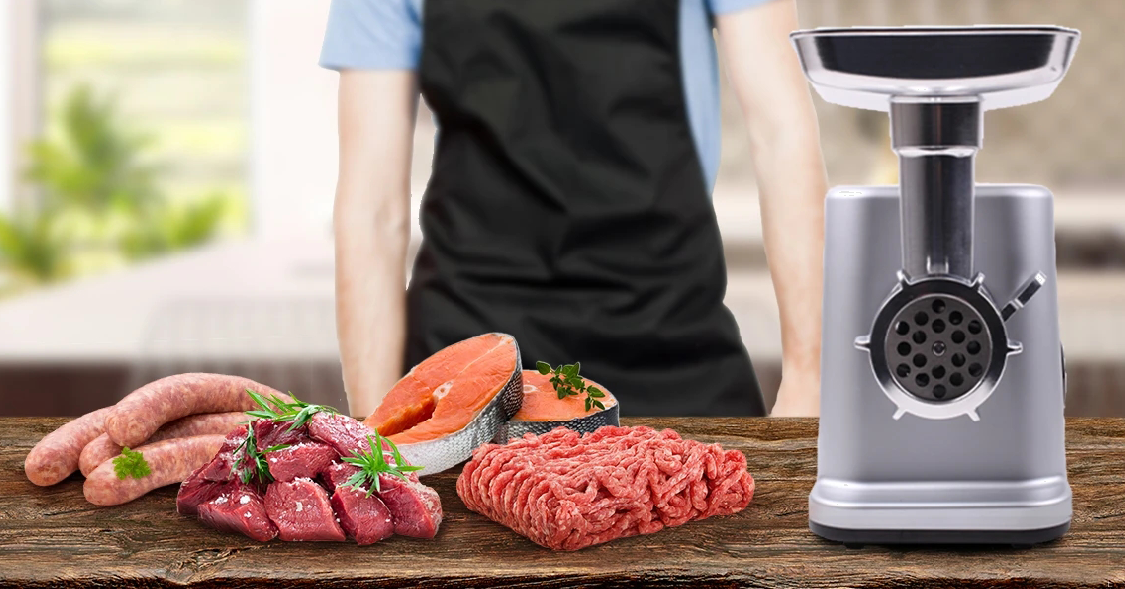
What Motor Does a Meat Grinder Use?
Not all meat grinders run on the same motor technology. Depending on the application — household, commercial, or industrial — four primary motor types are used, each with distinct performance characteristics.
1. Universal AC Motors
Universal AC motors are the most widely used meat grinder motor type in consumer-grade and entry-level appliances, and for good reason.
l How they work: The field winding (stator) and armature winding (rotor) are connected in series, allowing the motor to run on both AC and DC power. Mechanical carbon brushes handle the commutation.
l Performance profile: These motors deliver very high rotational speeds — typically 10,000 to 20,000 RPM — combined with strong starting torque in a compact, lightweight package. Power Motor's PU54 series, for example, includes the PU5425220 (300W, 11,000 RPM, 200 mN.m) and the PU5430230 (300W, 7,500 RPM, 380 mN.m), both featuring an integrated gearbox design that is long-life, small-volume, and purpose-built for meat grinders.
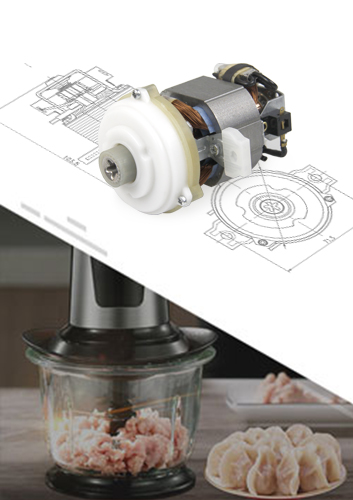
Picture shown: AC Universal Motor for Meat Grinder
l Best for: Household and small commercial meat grinders where compact size, cost efficiency, and power density matter.
l Limitations: Carbon brush wear generates friction, heat, and noise. These motors are not suited for continuous heavy-duty cycles and require periodic maintenance.
2. PMDC (Permanent-Magnet DC) Motors
PMDC motors use permanent magnets to generate the stator field instead of electromagnetic coils, making the motor structure simpler and the magnetic circuit more stable.
l How they work: A DC power source drives the armature through brushes and a commutator, while the permanent magnets provide a consistent field. A gearbox is usually used to reduce output speed and multiply torque.
l Performance profile: Compared to basic universal AC motors, a well-optimized PMDC gearbox solution offers improved torque output, quieter operation (noise reduced to approximately 65 dB versus 85+ dB for standard AC solutions), and longer service life.
l Best for: Compact household meat grinders where speed control flexibility and reduced noise are priorities.
l Limitations: Brushed PMDC motors still involve mechanical wear. In small form-factor appliances, thermal overload under sustained use remains a consideration.
3. BLDC (Brushless DC) Motors
BLDC motors represent the most advanced and increasingly preferred technology for high-end and next-generation meat grinders.
l How they work: Electronic controllers replace mechanical brushes entirely for commutation, eliminating friction at the source. Permanent magnets on the rotor interact with electronically switched stator windings.
l Performance profile: BLDC motors can achieve efficiency levels of 85–90%+, which is significantly higher than conventional universal AC motors. They consume less energy and produce less heat for the same grinding task, making them more efficient and suitable for battery-powered applications. Additionally, operating noise drops significantly, and the motor maintains consistent torque across a wide speed range. Built-in automatic overload and thermal protection are standard.
l Best for: Premium meat grinders and food processors where energy efficiency, low noise, longevity, and intelligent control are commercial differentiators.
l Limitations: Higher unit cost and greater control system complexity compared to universal AC solutions.
4. AC Gearmotors for Commercial and Industrial Grinders
For commercial butcher operations and industrial meat processing lines, neither high-speed AC motors nor compact DC motors are sufficient alone. These environments demand purpose-built AC gearmotor systems.
l How they work: A robust AC induction motor (typically 0.5–5 HP / 375W–3,700W) is paired with a reduction gearbox — helical, planetary, or worm gear — that dramatically lowers output shaft speed while multiplying torque.
l Performance profile: The system emphasizes low-speed, high-torque operation for stable long-term performance and high processing capacity. Excessive speeds can increase blade friction heat, resulting in a “smearing” effect where fat melts before cutting, damaging texture quality.
l Best for: Commercial and industrial grinders processing high volumes continuously, including sinew-heavy cuts and semi-frozen meat.
l Limitations: Larger physical footprint; not cost-effective for household applications.
Key Meat Grinder Motor Specs That Matter for Your Business
Selecting a motor for meat grinder applications goes well beyond cataloging motor types. The following specifications have a direct impact on product positioning, production economics, and end-user satisfaction.
1. Power Rating (W / HP)
Motor power sets the ceiling for processing capacity and commercial use cases. As a reference framework:
l 300W-800W (0.4-1 HP): Typically for household use, suitable for light daily processing.
l 500W–1,000W (0.7–1.3 HP): Suitable for small cafés, butcher shops, and entry-level commercial applications with moderate processing needs.
l 1,100W–1,500W+ (1.5–2 HP): Designed for busy butcher shops and high-throughput restaurant operations as a mainstream commercial solution.
l 2,250W+ (3–5 HP): Intended for industrial production lines requiring continuous, non-stop operation.
2. Torque and Speed (RPM)
In meat grinder applications, the balance between torque (force) and speed determines the quality of the final meat texture. As explained earlier, excessive blade speed can lead to frictional heating that melts fat before cutting. This creates a smeared, pasty texture rather than clean, well-defined particles. A gearbox is therefore used to convert high-speed motor input into controlled, high-torque output for stable performance.
For example, Power Motor’s PGM.174FP gear motor provides 179 rpm output speed with 12,200 mN.m torque, making it suitable for applications where controlled output and strong torque are required.
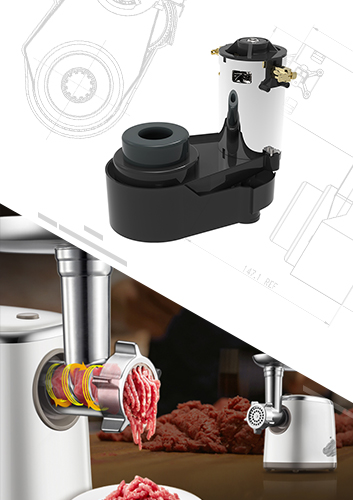
Picture shown: Meat Grinder Gear Motor
3. Duty Cycle, Cooling, and Protection
Duty cycle determines how long a motor can run before requiring a cool-down period.
A household meat grinder may only need intermittent operation. A restaurant, butcher shop, or food processing line may require longer runtime, stronger cooling, and more robust protection. If the motor is underspecified, it can overheat, lose performance, shorten service life, or fail prematurely.
OEMs should evaluate thermal protection, overload protection, winding material (pure copper windings offer excellent heat dissipation), gearbox lubrication, bearing quality, and airflow design. For advanced designs, sensors and controllers can also be used to detect abnormal loads and protect the motor system.
4. Energy Efficiency
BLDC motors are often preferred in premium designs because they can offer better efficiency and longer service life than brushed motor platforms. PMDC gearbox solutions can also improve application-level efficiency by better matching motor speed and torque to the grinder mechanism.
For OEMs, the best approach is to evaluate system efficiency, not only motor efficiency. The motor, gearbox, controller, blade sharpness, auger geometry, and housing design all affect final grinding performance.
Power Motor Offers Reliable Meat Grinder Motor Solutions
Power Motor has been engineering electric motor solutions since 2001, with more than two decades of focused expertise in kitchen appliance motors — including dedicated motors for meat grinders, food choppers, blenders, and high-speed mixers.

Beyond off-the-shelf products, Power Motor maintains an extensive motor prototype database and can rapidly configure solutions from over 100,000 possible combinations to match specific OEM requirements. Controllers, encoders, and gearboxes can be integrated to order.
With over 72,000 m² of production facilities, 40+ automated production lines, and a monthly output exceeding 3 million units, Power Motor delivers both engineering flexibility and the manufacturing scale needed for competitive cost structures.
Conclusion
So, what motor is used in a meat grinder? The answer depends on the grinder’s target market and working conditions. Household meat grinders often use universal AC motors or PMDC gearbox motors. Premium appliances may use BLDC motors for better efficiency, lower noise, and longer life. Commercial and industrial grinders often require AC gearmotors or high-torque gearbox systems.
For OEMs looking for a reliable meat grinder motor, the best choice is not simply the highest wattage motor. The right motor for meat grinder applications must balance torque, output speed, duty cycle, thermal protection, noise, efficiency, size, and cost.
For reliable Chinese electric motors for meat grinders, feel free to contact Power Motor.