
Wi-Fi connectivity adds a communication layer to motor control. Review commands, local protection and communication-loss behavior as separate design requirements.
1.Basic situation of smart home WIFI market
Wi-Fi connectivity adds remote commands and status reporting to a motor-control system. Treat communication and local motor control as separate design functions, with defined behavior for connection loss, invalid commands and reconnection.
2.Market demand and pain points
As the modern Internet of Things (IoT) evolves and technological advancements continue, people's aspirations for a higher quality of life have transcended traditional boundaries, leading to the rise of intelligent living. In this transformation, WIFI plays a pivotal role as a core connection hub, permeating the smart home ecosystem like capillaries. As a widely adopted wireless communication foundation, it has revolutionized the traditional manual control model, allowing users to remotely manage devices via mobile apps, thereby enhancing the convenience of daily life through seamless smart interactions.
For further selection, review motor-controller catalogue. Check voltage, current, feedback and protection against the motor; a catalogue link does not establish a validated pairing.
3.Introduction to the superposition WIFI control scheme of motor control board
1) Introduction to the frame of motor control board with WIFI control
The framework is based on the 220V brushless motor scheme of mains electricity. This solution features protection mechanisms against overcurrent, overvoltage, and overheating. It uses 220V AC power, which is rectified and filtered by a rectifier bridge before being supplied to the motor control end. A drive IC generates six signals with dead zones, which are then controlled by a three-phase inverter bridge to operate the motor. Position/speed sensors and current sensors monitor the motor's dynamic response. The WIFI module communicates with the main MCU via a serial port (UART) or SPI. Users can send commands through a mobile APP or Web interface, which are transmitted to the MCU via the WIFI module to control the motor The start and stop, speed, direction, etc. of the machine are shown in the following scheme function block diagram:
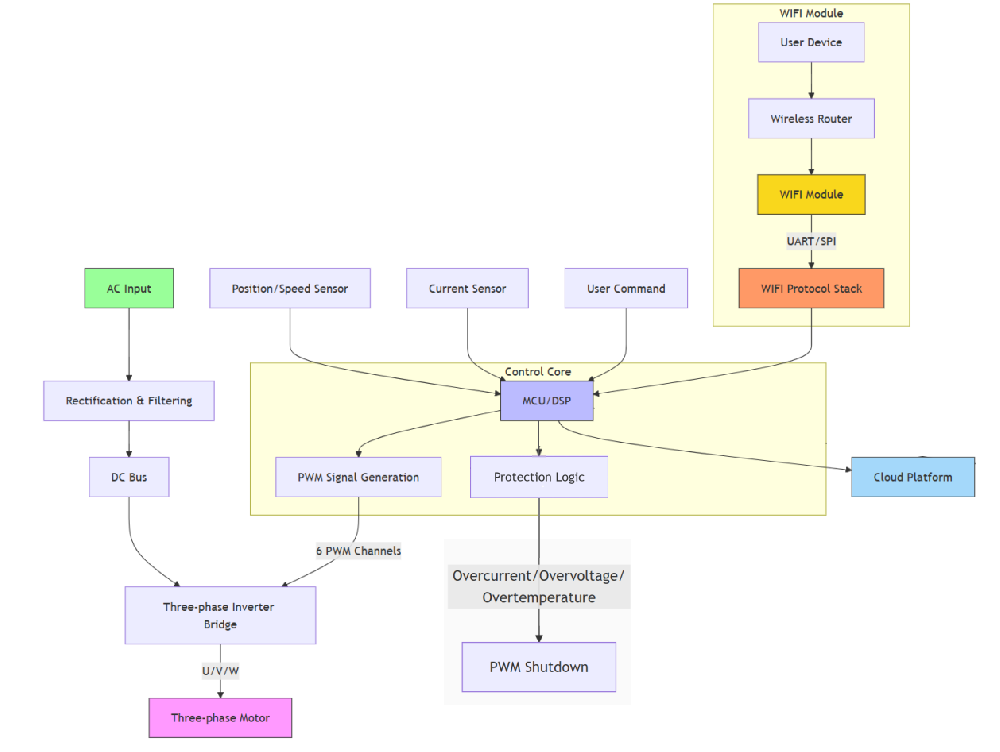
2)Introduction of motor drive and WIFI interaction process
Shenzhen Power Motor, building on the standard motor control board solution, has added a WIFI module. This module connects to a remote server via the TCP protocol to facilitate the transmission and reception of AT commands. Additionally, the WIFI module can send commands to the main controller through the mobile APP via , which then transmits data to the main controller via UART, enabling the motor's start/stop, speed adjustment, and direction control. The system also allows for data feedback, which is transmitted to the mobile APP via the cloud platform. The interaction flowchart is as follows:
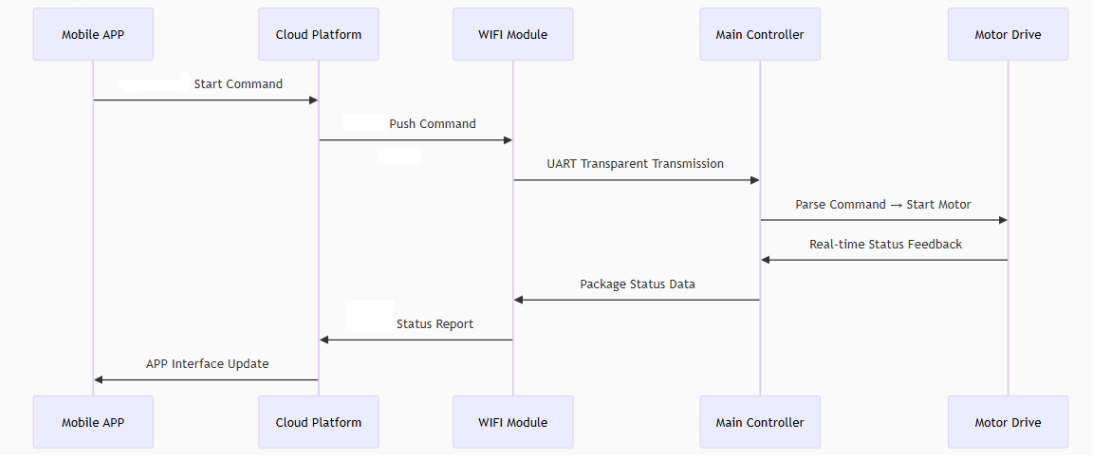
4. Future expectations
Shenzhen Power's motor control board, enhanced with WIFI control technology, enables users to remotely operate the device from anywhere and anytime, significantly enhancing convenience and operational safety. As technology continues to advance and innovate, Lihui's motor control board with WIFI control technology will continue to be optimized and upgraded, improving performance and reliability, ultimately providing users with a smoother, smarter, and more superior user experience.
For a motor selection enquiry related to this article, share the application, supply, load, duty cycle and installation requirements through our contact page.
Note: This article is contributed by Research and Development Department