Technical Guides

Basic knowledge | Why is the single-phase universal motor a dual-purpose AC and DC motor?

A universal motor is a series-wound commutator motor designed for operation on a specified AC or DC supply. Its field and armature currents reverse together when supply polarity reverses, so the torque can remain in the same direction. This does not mean that every motor labelled “AC” can operate on DC.

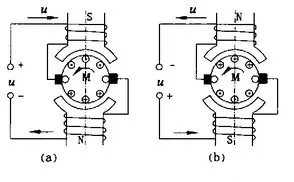
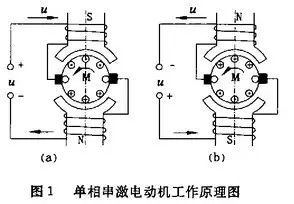
Why torque keeps the same direction

In the simplified series-motor model, torque depends on the interaction of field flux and armature current. Reversing both together preserves the torque direction. On AC, both reverse each half-cycle. The motor construction must also accommodate AC operation, including magnetic losses and commutation behavior.

Universal, PMDC and induction motors differ

MotorRelevant distinction
Universal motorSeries field and armature with a commutator; use its specified supply ratings
Brushed PMDCPermanent-magnet field; reversing suitable DC armature polarity can reverse torque
BLDCNeeds electronic commutation from a compatible drive
Induction motorUses an AC magnetic field; direct DC is not an equivalent supply

Does swapping the supply leads reverse a universal motor?

Normally, swapping both supply connections reverses both field and armature current, so it does not reverse torque. Reversal requires a supported change of the relative field/armature connection, and the exact motor construction may limit operation in the other direction. Brush geometry, fan direction and the driven mechanism also matter. Use the manufacturer’s connection diagram; this explanation is not a mains-wiring procedure.

Supply and speed control limits

The same numeric AC RMS and DC voltage do not establish identical performance. Confirm the specified supply, current, load, speed and temperature. A compatible AC universal-motor drive may use phase-angle control; its method and electromagnetic-compatibility requirements differ from those of a low-voltage PMDC PWM drive. Do not infer compatibility from connector shape or wire color.

Application checks

  • Confirm AC/DC ratings and the intended controller before connecting the motor.
  • Define the working load and allowed speed range; do not assume unloaded operation is acceptable.
  • Check cooling direction, brush wear, temperature and electrical noise in the final appliance.
  • Use the specific motor and drive documentation for protection and wiring requirements.

Current universal AC motors

Technical reference

Microchip AN2184: universal motor drive and control